
Cryopump Troubleshooting: Common Issues and Fixes
Troubleshoot common cryopump problems: ratchetting, low cooling capacity, oil contamination. Learn when to service vs. replace from vacuum experts. Cryopump troubleshooting is important
3 min read
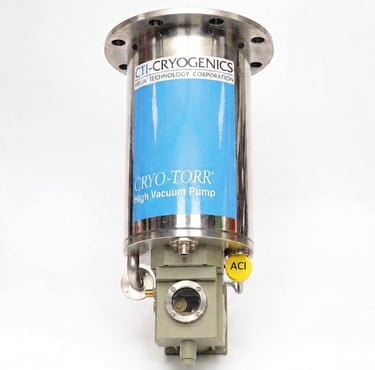
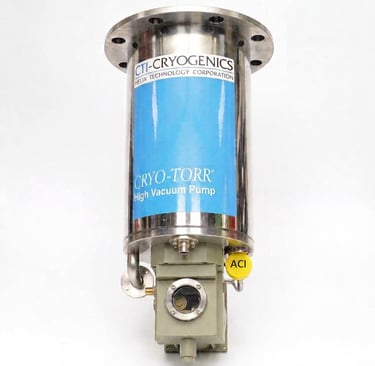
Cryopumps are reliable, but when they fail, they fail in predictable ways. Here are the most common problems we see - and what they mean.
Problem 1: Coldhead Ratchetting
The symptom: You hear a distinctive clicking or ratchetting sound from the coldhead, usually intermittent.
What it means: The helium circuit is contaminated with oil vapor or moisture. The displacer can't move smoothly, so it's stuttering.
Why it matters: Left unchecked, contamination progresses. The coldhead bearings wear out. Eventually, the displacer seizes completely and the pump stops cooling.
The fix:
Immediate: Stop using the pump. Run the compressor alone (no pump connected) to verify the compressor is clean.
Short-term: Install a decontamination manifold to trap oil vapor before it enters the coldhead.
Long-term: Replace the compressor absorber (if >12 months old), change helium lines, and have the coldhead rebuilt professionally.
Cost: $2,000-$5,000 for a coldhead rebuild vs. $15,000+ for a full pump replacement.
Problem 2: Low Cooling Capacity
The symptom: The cryopump reaches temperature, but pumping speed is slow. Pumpdown takes twice as long as it should.
What it means: The charcoal array is degraded, contaminated, or the coldhead temperature is drifting.
Why it matters: Low cooling = low pumping speed. Your process slows down. If you don't address it, the array will eventually reach saturation and stop working.
The fix:
Check temperature: Use WinOCC (On-Board models) or a temp probe to verify coldhead is reaching design temperature (typically 10-15K). If not, you have a cooling problem.
Check saturation: If temperature is good but speed is low, the charcoal array is likely saturated from previous regeneration cycles. A full regeneration cycle (8-12 hours) often restores capacity.
If problem persists: The array needs replacement. This is part of a standard cryopump rebuild.
Cost: $1,500-$3,000 for array replacement + labor.
Problem 3: Oil Contamination in Helium Circuit
The symptom: Visible oil in the helium lines, or On-Board sensor shows "oil contamination alarm."
What it means: Your compressor absorber is spent, or your helium lines are old and collecting oil residue.
Why it matters: Oil in the helium circuit kills the coldhead seals. It leads to ratchetting, then to seizure.
The fix:
Replace the absorber immediately (24-48 hour job, <$500).
Inspect helium lines for oil residue. If present, replace them ($800-$1,500 depending on length).
Run the compressor alone for 30 minutes to verify no more oil is present.
Reinstall the pump and monitor for recurrence.
Pro tip: Set a calendar reminder to replace the absorber every 12 months. It's cheaper than emergency repair.
Cost: $500-$2,000 depending on whether lines need replacement.
Problem 4: Pump Won't Start (No Coldhead Temperature)
The symptom: You power on the pump, but the coldhead never reaches operating temperature. WinOCC shows "no cold head detected" or "motor not running."
What it means: Could be compressor failure, motor bearing wear, or a control electronics issue.
Why it matters: The pump is down. You need to diagnose fast.
The fix:
Check the compressor independently. Disconnect the pump and run the compressor with a helium tank. If it compresses normally, the compressor is fine.
If compressor won't run: The motor or motor controller has failed. This requires professional service.
If compressor runs but pump won't cool: The thermal connection between compressor and coldhead is broken (bad fitting, kinked line, or seal failure).
Cost: $2,000-$7,000 depending on the root cause.
Problem 5: Pump Leaks Helium (Visible Frost on Exterior)
The symptom: You see frost or ice forming on the outside of the pump. Helium pressure won't hold.
What it means: You have a helium leak somewhere in the closed-loop circuit - either in the pump itself or in the lines.
Why it matters: You're losing expensive helium. The pump can't reach cold. Performance degrades.
The fix:
Locate the leak using a helium sniffer (mass spectrometer). It shows exactly where the leak is.
If it's in the lines: Replace the affected line ($800-$1,500).
If it's in the pump: The pump seal assembly needs replacement, which is part of a full pump rebuild.
Cost: $1,500-$5,000 depending on location.
When to Call for Help
If your troubleshooting points to a cryopump issue (not compressor, not lines), you need professional service. We have 25+ years of experience with these exact problems. Contact us with your symptoms and we'll guide you through the next step.
Contact Us
Support and inquiries welcome anytime.
Phone
sales@appliedcryogenics.com
1-510-252-9900
© 2026. All rights reserved.